 Vexaro Pest Services
Subterranean Termite Remediation & Monitoring
Eastern subterranean termites thrive across the dense woodland borders of Prince George's County, where sandy loam and clay soils retain high moisture levels along Mattawoman Creek and the Piscataway Park drainage…
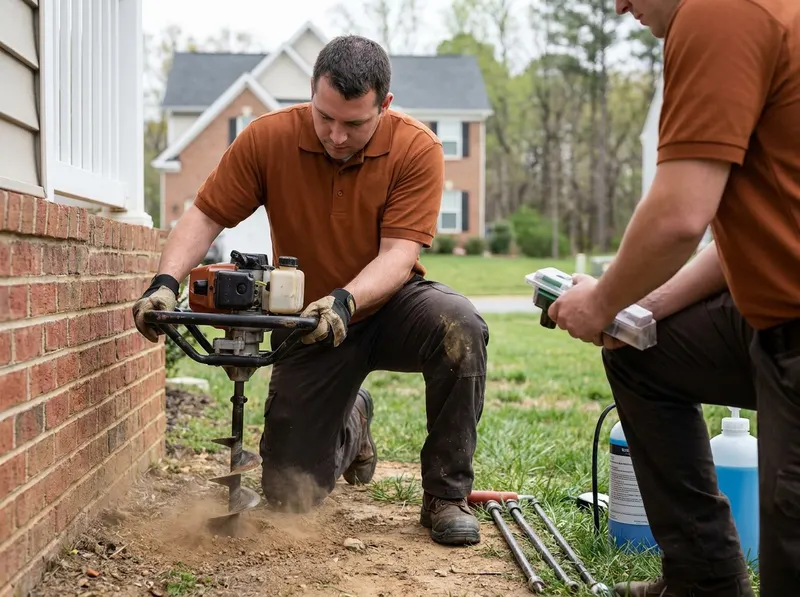
- What's included: Full crawl space and foundation inspection, non-repellent liquid barrier soil application, perimeter bait/monitoring station installation, and documented subterranean activity mapping.
- How fast: Initial diagnostic inspections take 60 to 90 minutes, with complete treatment system installation completed within a single morning or afternoon visit.
- What it costs: Comprehensive remediation and monitoring systems range from $850 to $2,600 depending on linear foundation footage, with localized spot treatments starting at the $250 service minimum.
- What we treat: Eastern subterranean termite worker colonies, reproductive swarmers, exploratory mud tubes along masonry, and moisture-compromised sill plates.
- How to book: Call (227) 722-4043 to schedule an on-site structural assessment where a technician evaluates your foundation, moisture levels, and soil profile.
Eastern subterranean termites thrive across the dense woodland borders of Prince George's County, where sandy loam and clay soils retain high moisture levels along Mattawoman Creek and the Piscataway Park drainage basin. Properties with wooded perimeter buffers in Moyaone Reserve, Simmons Acres, and Bryan Point face constant pressure from subterranean colonies feeding on damp decaying matter beneath the forest floor. When ambient spring soil temperatures reach roughly 70 degrees, reproductive swarmers emerge to establish new colonies, frequently utilizing hidden entry points such as slab expansion joints, hollow concrete block voids, and unsealed plumbing penetrations.
Effective defense requires halting subterranean foraging paths before insects access the sill plate. In neighborhoods like Manokeek, Farmington Landing, and Danville Estates, older crawl spaces and ground-level foundation footings demand a dual-layer strategy. A localized repellent spray merely reroutes worker termites to another section of the floor joists. In contrast, non-repellent liquid termiticide barriers allow foraging workers to pass through the treated zone undetected, transferring the active agent throughout the subterranean colony until the population collapses.
For properties with large wooded lots or private wells near Berry Hill and Cherry Hill Estates, in-ground monitoring stations provide ongoing perimeter detection. Technicians position monitoring stations at ten to twenty-foot intervals around the home perimeter. When worker termites intercept a station, the cellulose matrix is replaced with a targeted insect growth regulator that interrupts their molting cycle, neutralizing the threat without broad chemical dispersion into surrounding soil.
What it costs
Every job gets a firm, written price after a free on-site visit.
Common questions
How can I tell subterranean termite swarmers from flying ants around my Accokeek home?
Will termite remediation chemicals affect my private water well in Moyaone Reserve or Accokeek?
Why do Accokeek crawl spaces experience higher subterranean termite activity?
How long does a liquid barrier treatment protect a foundation in Accokeek, MD?
Are monitoring stations alone enough to stop an active termite infestation in Accokeek?
Ready to get started?
Tell us about your subterranean termite remediation & monitoring job in Accokeek and we'll send a clear, written quote — usually the same day.